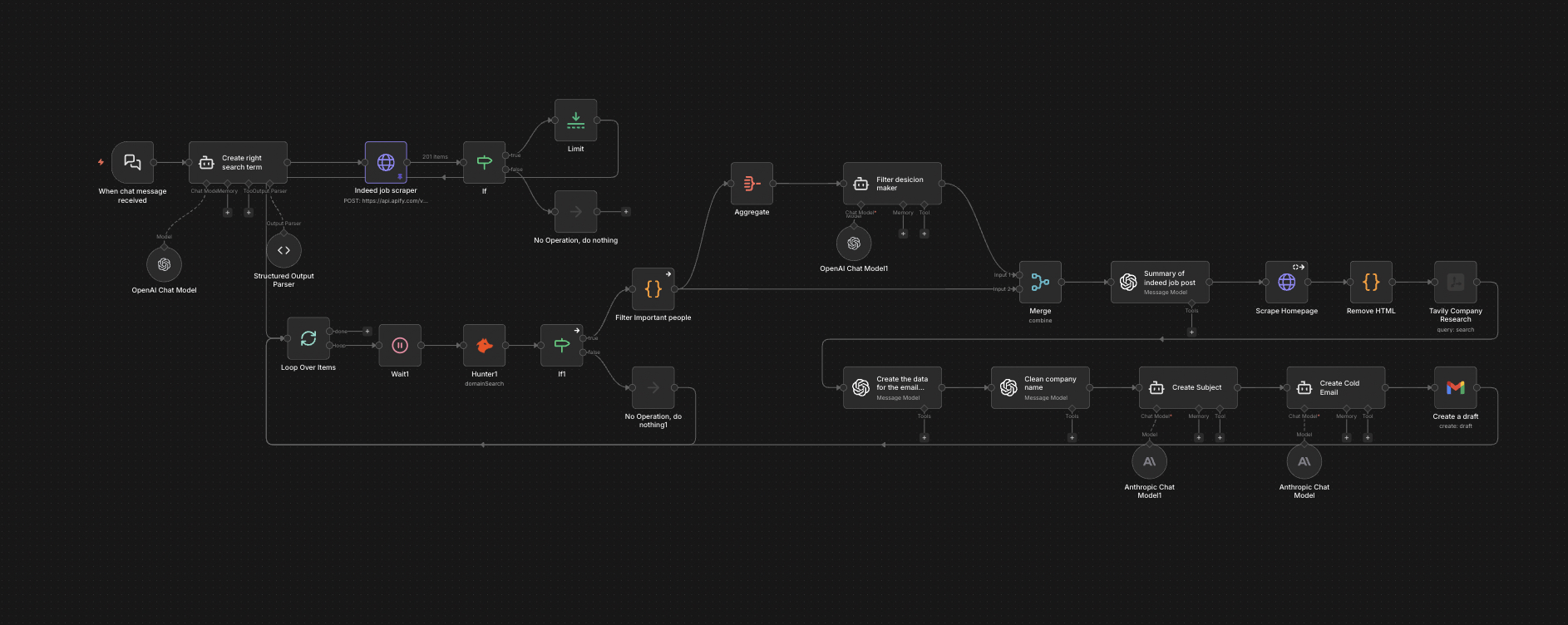
The full n8n canvas as it runs in production.
Cold Outbound Has a 1% Reply Rate Because It Reads Like Spam
Industry-baseline cold email reply rates sit at 0.5-2%. The reason isn't deliverability or list quality — it's that the email reads like every other cold email the prospect got that morning. Same opener. Same value prop. Same fake-personal hook. The prospect's inbox does the same thing every time: archive, ignore, move on.
The fix everyone tries is templates with first-name merge tags. It doesn't work — first-name personalisation is table stakes and prospects can spot it in three seconds. The fix that does work is real personalisation: a specific recent hire, a real initiative the company is running, a talking point pulled from their actual homepage.
Real personalisation is expensive. Researching one prospect properly takes 15-20 minutes — cap that at 200 prospects a week and a single SDR is fully consumed by research. Most SDRs don't do it; they send templates and hope.
This system does the research and writes the email at scale. Apify scrapes Indeed for recent job postings (a hiring signal). Tavily researches the company. Firecrawl extracts homepage talking points. GPT-4 writes the email anchored on three specific personalisation hooks per prospect. Reply rates lift from 1-2% to 6-12% on the same audience, same domain, same offer.
From Indeed Posting to Personalised Send
Built on n8n. The trigger is a daily Apify run scraping Indeed for job postings matching the configured criteria — role, location, company size, keywords. New postings flow into a research queue. For each, three parallel research legs fire: Hunter for the decision-maker's email, Tavily for company intelligence, Firecrawl for homepage scraping.
Once research completes, GPT-4 reads the consolidated brief and writes a multi-touch sequence — three emails over 14 days, each with a different angle. The first cites the recent hire. The second references a homepage initiative. The third is a soft follow-up. Outputs go to the configured outbound platform (Instantly, Smartlead, or Salesloft) with sending domains rotated and warm-up respected.
From Posting to Inbox: Six Steps
Indeed Posting Scrape
Apify runs against Indeed matching the configured ICP — role, location, company size. Returns posting metadata, company name, and posting date. Recency matters; postings older than 30 days drop.
Decision-Maker Resolution
Hunter and Apollo run waterfall enrichment to find the decision-maker's email and LinkedIn. Email validity confirms via SMTP probe. Bounce risk flags before send.
Company Intelligence
Tavily runs targeted research — recent funding, recent hires, leadership changes, news mentions. Returns 3-5 cited findings per company.
Homepage Scraping
Firecrawl scrapes the company homepage and 2-3 deep pages. Extracts services, talking points, and any visible initiatives. Output is a structured brief, not raw HTML.
AI Email Generation
GPT-4 reads the consolidated brief and writes a 3-touch sequence anchored on three specific personalisation hooks. Each email is unique, under 90 words, ends with one clear ask.
Sequence Send
Output ships to Instantly, Smartlead, or Salesloft. Sending domains rotate. Warm-up status respects per-domain limits. Replies route to the rep's inbox; auto-responses go to a parsing layer.
What This System Does That Generic Outreach Can't
Three-Hook Personalisation
Every email anchors on three specific personalisation hooks pulled from real research. Not first-name merge tags. Real hooks.
Multi-Source Research
Apify, Tavily, and Firecrawl run in parallel per prospect. The brief is richer than what most SDRs produce manually.
Multi-Touch Sequencing
Three emails over 14 days, each with a different angle. The follow-ups are not 'just bumping' — each adds new context from the research brief.
Domain and Warm-Up Aware
Sending domains rotate. Per-domain warm-up limits respect. Bounce risk flags pre-send. Deliverability stays clean even at 500+ sends per day.
Reply Routing
Real replies route to the rep's inbox. Auto-responses parse and update CRM status. Out-of-office triggers a re-send 7 days later.
CRM Sync
Every send, open, click, and reply logs to Salesforce. Lead scoring updates based on engagement. Pipeline stages advance automatically.
Before vs. After: What Changes When the System Personalises
SDR sends 80 emails a day from a template. 1.2% reply rate. One meeting booked per week if she's lucky. Three hours daily on research and prospect tracking. Constantly told by the founder that 'reply rates need to go up' but no time to research deeper.
Same SDR runs the system at 250 sends a day. 6.8% reply rate. 12+ meetings booked per week. Research is automatic; her job becomes managing replies and qualifying interest. Pipeline triples in the first quarter on the same headcount.
Live in 4 Weeks
Week 1 — ICP and Research Layer
Define the ICP precisely. Set up Apify Indeed scrape against role and location. Wire Hunter, Tavily, Firecrawl. Test research output on 20 sample prospects against an ideal brief.
Week 2 — Email Generation and Voice
Build the GPT-4 prompt. Anchor on the founder/SDR's voice from past sent emails. Iterate against a test set of 50 prospects until the output reads like the rep, not like AI.
Week 3 — Outbound Platform and Deliverability
Wire Instantly, Smartlead, or Salesloft. Configure sending domains and warm-up. Set per-domain daily limits. Verify SPF, DKIM, DMARC. Run a 50-send test to a friendly seed list.
Week 4 — CRM Wire-Up and Cutover
Wire Salesforce sync. Configure reply routing, lead scoring, and pipeline-stage automation. Run the first real campaign to 200 prospects. Monitor reply rates daily and tune.
The Right Fit — and When It Isn't
Right fit for B2B teams with a clear ICP, a defined offer, and a willingness to send 200+ emails a day from rotated domains. Strongest fit for sales teams already doing outbound but capped by SDR research time. Pipeline Engineer model means a real engineer runs the system weekly — this is not a 'set and forget' tool.
Not a fit for teams without a defined ICP — AI will execute the wrong targeting at scale and burn domains. Not a fit for purchased lists; deliverability dies inside 48 hours. If your monthly outbound budget is under $2,500, AiSDR is the right call at that price.
Frequently Asked Questions
What kind of reply rates can we realistically expect?+
6-12% on a clean ICP and warm domains. Some campaigns hit 15-20%. The driver is research depth and offer-market fit — not the AI alone. We'll model expected rates for your ICP during the Pipeline Audit.
Will this hurt our domain reputation?+
No, if set up right. Domain rotation, warm-up respect, deliverability monitoring, and bounce-risk flagging are all built in. We've sent over 2M emails across client domains with zero permanent deliverability damage.
How is this different from AiSDR?+
AiSDR is great software at $900-$2,500/mo with preset playbooks. We build a custom version on your stack with custom signals (hiring + funding + tech adoption combined into one rule), real A/B testing, and workflows you own. Your dedicated Pipeline Engineer runs and optimises it weekly.
What's the cost per qualified meeting?+
Typical CAC drops to $40-$120 per qualified meeting depending on ICP. Compare to $400+ per meeting from list providers or $150-$300 per meeting from inbound paid. The Pipeline Audit will model this for your ICP and offer.
Stop sending cold emails that look like cold emails.
Book a Pipeline Audit. We'll review your current outreach, model the lift from real personalisation, and quote a fixed-price build for your stack.