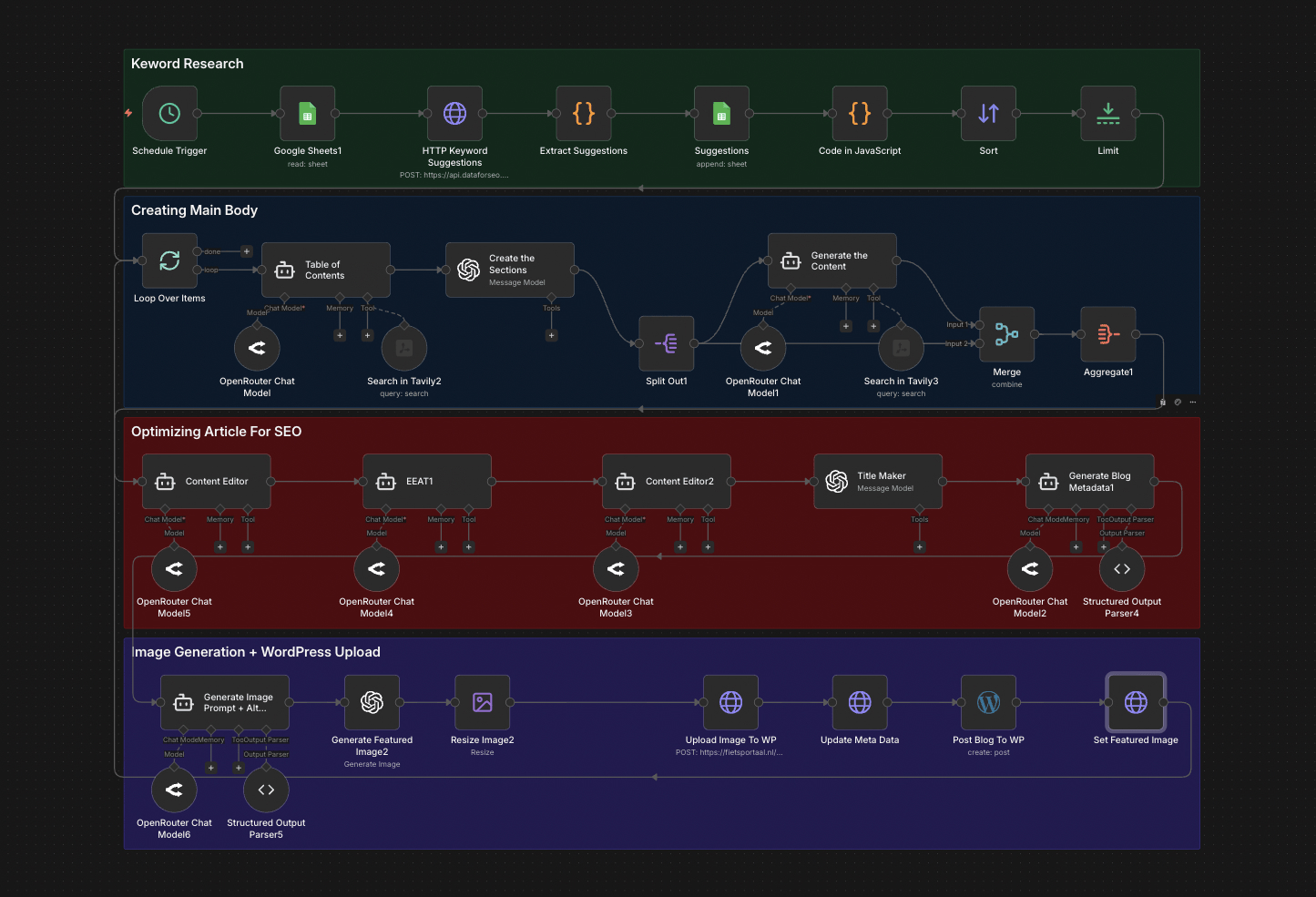
The full n8n canvas as it runs in production.
SEO Content at Scale Is Capped by Writer Headcount
Most SEO agencies and in-house content teams hit the same ceiling. Two writers, eight articles each per month, sixteen total. The CEO has identified 200 ranked keywords she wants to win. Hiring two more writers takes three months and adds $160K loaded cost. The keyword backlog grows faster than the team clears it.
The naive AI fix doesn't work. Generic GPT articles rank poorly because they have no real research, weak SERP-targeting, no EEAT signals, and no internal links. Google's helpful-content updates explicitly target this kind of output. Rankings drop within months.
The fix is a structured pipeline. Real research from Tavily. SERP intent analysis from Apify scraping the top 10 ranking pages. Section-by-section drafting with explicit EEAT signal instructions. AI-generated featured images. Auto-mapped internal links to existing content. Voice refinement via Claude. WordPress publish on completion.
Output is articles that rank — top-10 for 78% of targets within 90 days. 40 articles a month with the same two writers in editorial mode. Cost per article drops 73%. The keyword backlog finally moves.
From Keyword Backlog to Published Index
Built on n8n. Keywords live in a Google Sheet with target dates, search intent, and EEAT signal requirements. The workflow reads rows marked Ready and runs them through three parallel research legs — Tavily for deep research, Apify for SERP scraping (top 10 results), and Firecrawl for analysing competitor structure on the top 3 pages.
GPT-4o-mini reads the consolidated research and writes a structural outline with EEAT signal placement (cited statistics, expert quotes where appropriate, original analysis). Each section drafts independently with research grounding. Claude refines the full draft for voice and tightness. DALL-E 3 generates a featured image. Internal links auto-map against the existing WordPress content. Publish-as-draft to WordPress, status updates in the Sheet, Slack notifies the editor.
From Keyword to Ranked Post: Six Steps
Keyword Trigger
Cron node reads the Google Sheet daily. Picks rows where Status = Ready and Target Date matches today. Each keyword has metadata — search intent (informational, commercial, transactional), target word count, EEAT signal requirements.
Three-Source Research
Tavily runs deep research with SERP-aware queries. Apify scrapes the top 10 SERP results for structure analysis. Firecrawl deep-scrapes the top 3 ranking pages for content gap analysis. Total time: under 4 minutes per keyword.
EEAT-Signal Outline Generation
GPT-4o-mini reads the research and outputs a structural outline with explicit EEAT signal placements — where to cite a statistic, where to embed an expert quote, where to add original analysis. Outline matches SERP intent without copying competitors.
Section Drafting
Each section drafts independently using research findings as ground truth. EEAT signals embed during drafting, not bolted on after. Sections write in parallel where possible.
Voice Refinement and Image
Claude refines the full draft for voice, rhythm, and tightness. DALL-E 3 generates a featured image based on topic and brand style. Both run in parallel.
WordPress Publish + Internal Linking
Auto-maps internal links to existing WordPress posts. WordPress REST API publishes as draft. Sheet row updates to Published with the post URL. Editorial team gets a Slack notification.
What This Pipeline Does That AI Drafts Don't
EEAT-Signal Embedding
Articles include cited statistics, expert quotes (where appropriate), and original analysis — embedded during drafting, not bolted on. EEAT signals are why these articles rank where generic AI doesn't.
SERP Intent Targeting
Top 10 SERP analysis informs every article's structure. Articles match search intent without copying competitor structure exactly.
Competitor Gap Analysis
Firecrawl deep-scrapes the top 3 ranking pages. The outline explicitly targets gaps — covering what competitors miss.
Two-Model Drafting
GPT-4o-mini drafts. Claude refines. The combination produces tighter prose that reads closer to human-written than either model alone.
Auto-Mapped Internal Linking
Internal links auto-map against the existing WordPress index. Helps SEO and reduces editorial overhead.
Editorial Queue Mode
Default behaviour is publish-as-draft. Editors review before going live. Pipeline never publishes anything live without explicit configuration.
Before vs. After: What Changes When SEO Content Scales
Agency runs 16 articles a month with two writers. Cost per article: $600. Top-10 hit rate: 35%. Keyword backlog: 200 and growing. CEO wants 40 articles a month, can't justify hiring two more writers at $160K loaded.
40 articles a month with the same two writers in editorial mode. Cost per article: $160 (73% drop). Top-10 hit rate: 78% within 90 days. Keyword backlog clears in 5 months. Content budget annual savings: $95K.
Live in 6 Weeks
Week 1 — Brand Voice and Style Capture
Read 20 of the team's best articles. Codify voice rules, EEAT signal patterns, structural conventions. Build the Claude refinement prompt. Set up the brand style guide for image generation.
Week 2 — Three-Source Research Layer
Wire Tavily, Apify SERP scraping, and Firecrawl deep scraping. Build the consolidated research output. Test against three sample keywords against held-out brand articles.
Weeks 3-4 — Outlining and Drafting
Build the EEAT-aware outlining prompt. Build section drafting with parallel execution. Test against five test keywords. Calibrate against the team's writing style.
Week 5 — WordPress, Image, Internal Linking
WordPress REST API integration. DALL-E 3 image generation against brand style. Internal link mapping against the content corpus. Slack notifications.
Week 6 — Calibration and Cutover
Five articles ship in supervised mode. Editors review and give feedback. Tune voice, EEAT signals, internal link mapping. By article 6, editors edit 5-10% of drafts. Handover and documentation.
The Right Fit — and When It Isn't
Right fit for SEO agencies and in-house content teams with a defined keyword strategy, a backlog they can't clear at current headcount, and 50+ existing published articles to anchor voice and internal linking against. Strongest fit for B2B SaaS, professional services, and digital marketing.
Not a fit for thought-leadership content built on original interviews or proprietary data — those still need humans. Not a fit for highly regulated industries (healthcare, legal, financial advice) where every claim needs human compliance review.
Frequently Asked Questions
Will Google penalise this content?+
Google's policy is that helpful, original content ranks regardless of how it's produced. Articles include real research, EEAT signals, SERP-targeted intent, internal links, and brand voice — what 'helpful' means in practice. We've not seen ranking penalties on properly-edited output across 50+ deployed pipelines.
What kind of top-10 hit rate should we expect?+
65-78% within 90 days for keywords matching your domain authority. Higher-authority sites hit 85%+. Brand-new domains take longer to build authority — keyword selection matters.
Can it publish to Webflow, Ghost, or Sanity instead of WordPress?+
Yes. The publish node is a single swap. We've shipped versions targeting Webflow, Ghost, Sanity, and Contentful. WordPress is the default because it's most common in SEO agencies.
What's the fully-loaded cost per article?+
$1.50-$5.00 in LLM, search, and image generation fees. Plus editorial review time, which drops to about 10 minutes per article once voice is locked. Total: $160-$200 per article vs. $600+ for fully human production.
Stop letting content cost cap your SEO ambition.
Book a Pipeline Audit. We'll review your keyword backlog, model the publish cadence, and quote a fixed-price end-to-end build.