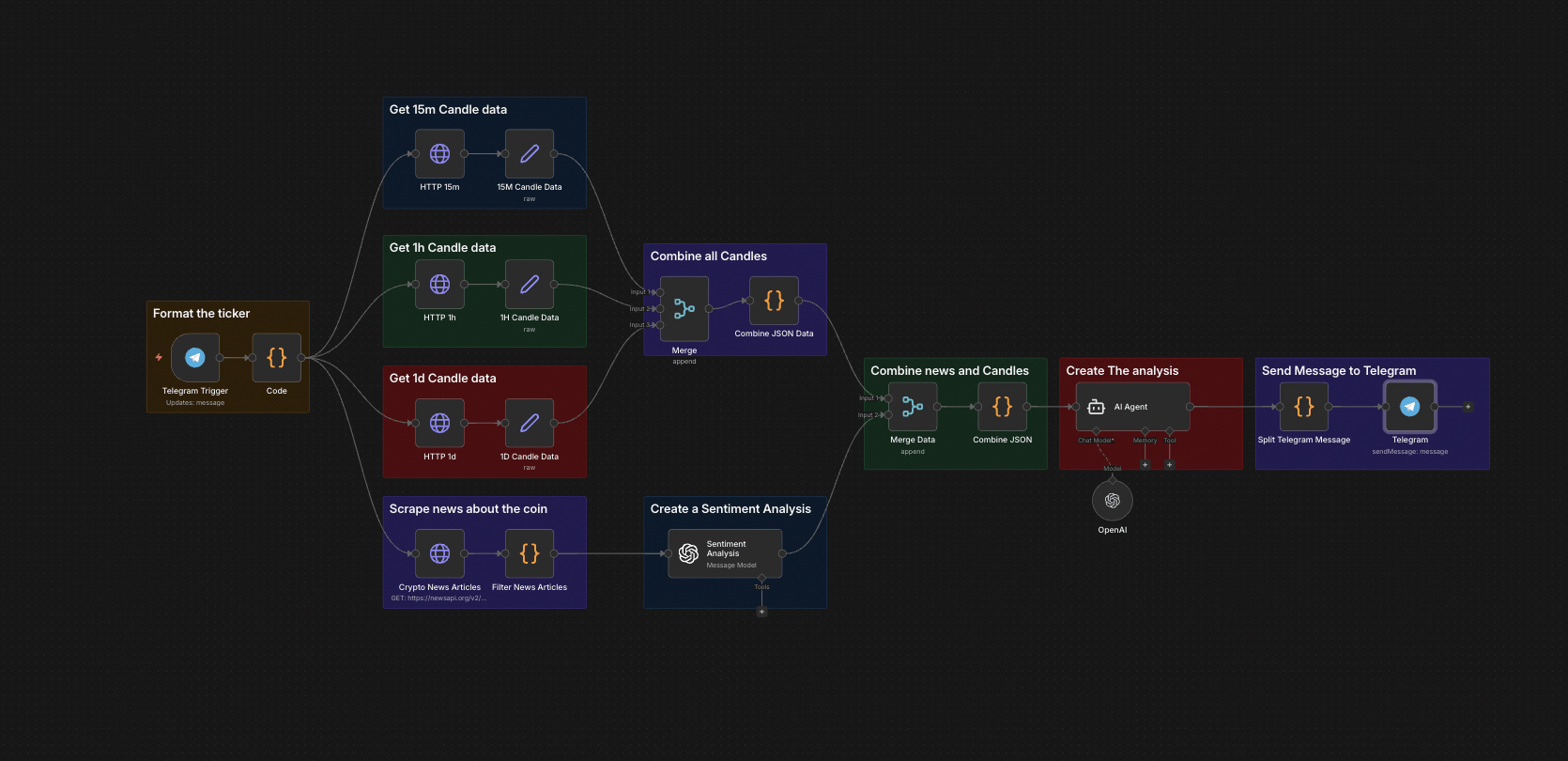
The full n8n canvas as it runs in production.
Five Tabs of Charts Is Not a Strategy
Most crypto traders spend the day looking at price screens. Five tabs of TradingView. CoinGecko in another. Reddit on the side. Twitter. Discord. The result is fatigue, not signal — anything that mattered already moved by the time it caught the trader's eye.
Manual monitoring fails for two reasons. First, attention is finite — a human can watch maybe 3-5 charts at once before missing things. Second, humans pattern-match poorly when tired. Anomalies in the 200th coin of the day don't register the way the 5th coin's anomaly did.
The fix is rule-based monitoring that runs continuously. Not 'AI predicts the market'. Just disciplined attention applied at scale — flag this volume anomaly, flag this RSI divergence, flag this 24-hour outlier move. The trader gets pinged only when the rules say something matters.
This system monitors 200+ coins every minute. Configurable rules detect price moves, volume anomalies, RSI extremes, and divergences. AI summarises why each alert fired. The trader's Telegram pings only when something is real. Five tabs of charts collapse into one signal feed.
From CoinGecko Tick to Telegram Alert
Built on n8n. A scheduled trigger fires every minute and queries CoinGecko's API for the watchlist (200+ coins). Latest prices, volume, and 24-hour movements pull into memory. Each coin runs through the configured rule library — price thresholds, volume Z-score, RSI extremes, cross-coin divergences.
Rules that fire generate a draft alert. GPT-4o-mini reads the rule trigger and the recent price/volume context, writes a one-sentence summary explaining the alert, and ships to Telegram with the ticker, current price, and chart link. Alert deduplication prevents the same coin from spamming — once an alert fires, it cools down for a configurable window before re-eligible.
From Watchlist to Alert in 60 Seconds
Scheduled Tick
n8n cron fires every 60 seconds. Queries CoinGecko's API for the configured watchlist. Returns latest price, volume, market cap, and 24h change for each coin.
Indicator Calculation
RSI, volume Z-score, price velocity, and divergence indicators calculate from the latest tick plus the coin's recent history. Indicators store in a rolling cache.
Rule Evaluation
Each coin's indicators check against the configured rule library — RSI > 70 flag, volume Z-score > 3 flag, price move > 8% in 1h flag. Rules are configurable per coin or per coin class.
Cooldown and Deduplication
If a coin has already alerted in the last cooldown window (default 30 min), the alert suppresses. Prevents rapid re-firing during sustained moves.
AI Summary
For each fresh alert, GPT-4o-mini reads the rule trigger plus recent price/volume context and writes a one-sentence summary. 'BTC breaking 24h volume Z-score on 6% upmove — possibly catalyst-driven, no obvious news yet.'
Telegram Delivery
Alert ships to the configured Telegram channel with the ticker, summary, current price, and a chart link. Hot alerts include a 'one-click drill-down' that triggers a full analysis (similar to the Stock Analysis Agent flow).
What This System Does That Manual Monitoring Can't
200+ Coins Concurrently
Watchlist scales with no attention cost. The system covers all of top-200 by market cap if configured. Adding a new coin is a one-line config change.
Rule-Based, Not Predictive
Honest framing — the system flags anomalies based on configured rules, not 'predictions'. The trader's job is to interpret the signal, not to trust the AI's call.
Cooldown by Default
Alert fatigue is the enemy. Each coin can only re-alert after a configurable cooldown. Most traders settle on 30-60 minutes.
Multi-Indicator Stacking
Rules can combine indicators — 'volume Z-score > 3 AND price move > 5% AND RSI < 30' = single alert. Avoids single-noise-source false positives.
AI Context Summary
Each alert includes a one-sentence explanation of why it fired. Saves the trader 10-15 seconds per alert verifying. Across 50 alerts a day, that's meaningful.
Drill-Down Integration
Hot alerts include a one-click trigger to a deeper analysis — full chart context, news scan, sentiment. The trader stays in Telegram but gets full diligence in 30 seconds.
Before vs. After: What Changes When the Watchlist Watches Itself
Trader keeps 5-7 chart tabs open. Cycles through them every 15-20 minutes. Misses two real moves that day because the trader was on lunch. Catches three head-fakes that the trader chased in real-time and lost on. Total focus time spent on monitoring: 6+ hours.
Trader closes the chart tabs. Telegram pings 8-12 times a day with real signal. Each ping has a one-line explanation. Trader investigates each in 30-60 seconds and decides whether to act. Total focus time spent on monitoring: under an hour. Pipeline of trade ideas triples; quality goes up because alerts are rule-checked.
Live in 2 Weeks
Days 1-3 — Watchlist and Rule Definition
Confirm the watchlist (which coins, which exchanges). Codify the trader's existing manual rules into structured form. Decide cooldown windows and alert routing.
Days 4-9 — Indicator Calculation and Rule Engine
Build the data pull from CoinGecko. Wire indicator calculations (RSI, volume Z-score, price velocity). Build the rule evaluation engine. Test against historical replay.
Days 10-12 — AI Summary and Telegram
Wire GPT-4o-mini summary generation. Build Telegram delivery with chart links and one-click drill-down. Test alert volume against the trader's expectations.
Days 13-14 — Cooldown Tuning and Cutover
Run the system in shadow mode for two days. Compare alerts to what the trader would have flagged manually. Tune cooldowns and rule thresholds. Go live.
The Right Fit — and When It Isn't
Right fit for active crypto traders, small crypto desks, and quant teams who already have a rule-based view on what 'signal' looks like. Works best when the trader can articulate their existing manual scanning rules.
Not a fit for traders who want the AI to invent the strategy — the system runs the trader's rules at scale, it doesn't generate alpha from nothing. Not a fit for HFT or sub-second strategies — the architecture is minute-resolution by design.
Frequently Asked Questions
Can this trigger automated trades?+
It can, with explicit configuration. Default behaviour is alert-only. Live trading hooks (Binance, Coinbase Pro, Bybit) bolt on with strict pre-trade checks if the desk wants it. Most clients keep humans in the loop.
How do you avoid alerting on every tiny move?+
Cooldowns, multi-indicator rule stacking, and configurable thresholds all reduce noise. We tune during the 2-day shadow run. Production alert volume settles at 8-15 signals per day across 200 coins for most traders.
What if CoinGecko's API rate-limits us?+
We batch requests and cache aggressively. CoinGecko's free tier supports the typical watchlist; paid tier handles 500+ coins easily. Architecture handles retry-with-backoff transparently.
Can it monitor on-chain data, not just price?+
Yes with additional integrations — Etherscan, Glassnode, Nansen all swap in. On-chain rules (whale wallet movements, large transfers, smart contract events) work the same way as price rules.
Stop watching five browser tabs of charts all day.
Book a Pipeline Audit. We'll scope your watchlist, design the alert rubric, and quote a fixed-price build that pings only when it matters.