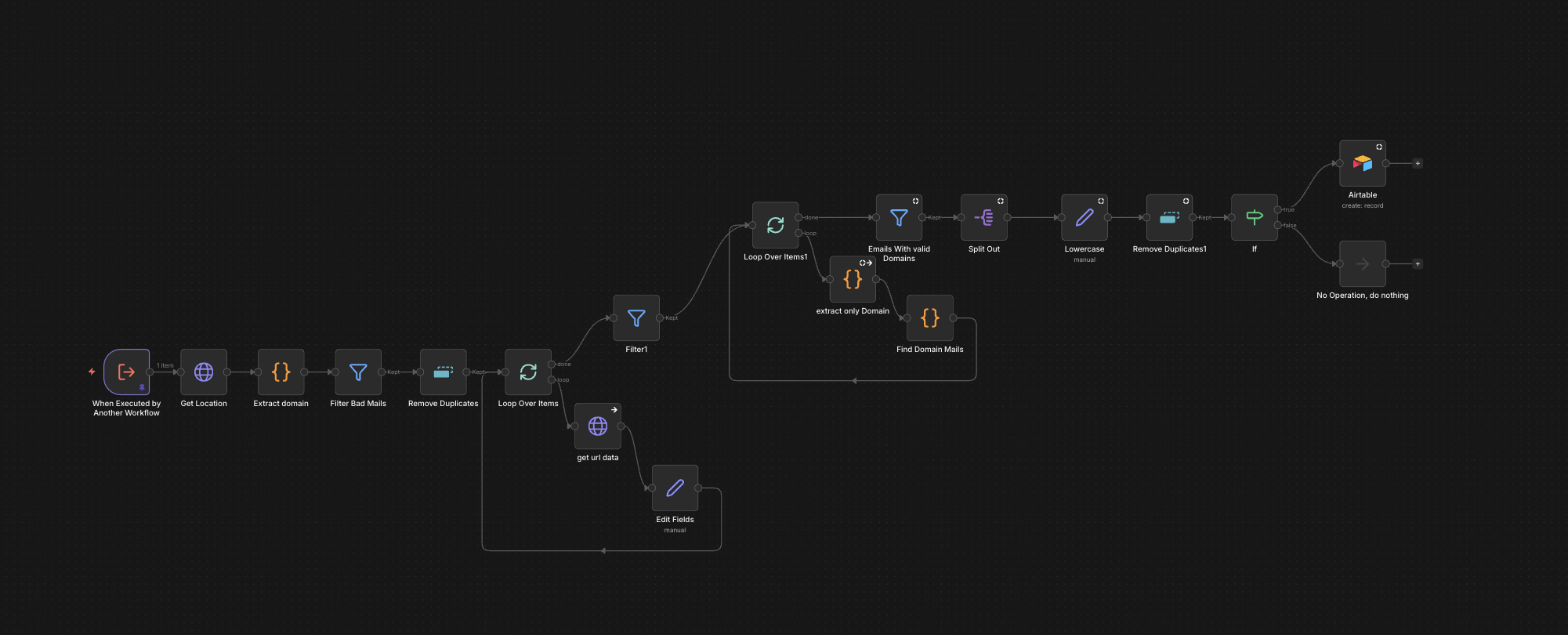
The full n8n canvas as it runs in production.
Local B2B Lead Lists Are Stale Before You Pay for Them
Most local marketing agencies and field-sales teams buy lead lists from data providers. The lists arrive with three problems. First, they're 6-18 months old. Second, the email accuracy is 40-60%. Third, every other agency in the city already has the same list.
Google Maps has the freshest local business data on the internet. It's verified, current, and includes contacts the data providers don't have. The catch is scale — manually scraping Maps by city and vertical takes a junior researcher 8-12 hours per geo.
The fix is a workflow that does the same scrape in 30 minutes, runs email validation in parallel, and outputs a clean Airtable view ready for outreach. Run it Monday morning for the next city. Have a fresh, verified, deduplicated list of 400+ leads by lunch.
This is the lead-gen layer that pairs with cold-email outreach. Run it weekly per geo. Never run out of fresh, current leads. Stop buying recycled lists that everyone else already has.
From Search Query to Verified Lead List
Built on n8n. The trigger is a configured query — keyword, location, radius, business count target. Apify's Google Maps actor runs the scrape and returns business names, addresses, phones, websites, ratings, and any visible emails. Output flows into a deduplication leg.
Each unique business runs through Hunter's email-finder API to surface a decision-maker email if Maps didn't expose one. SMTP probes confirm validity. The clean list lands in Airtable with status fields ready for outreach. Bounce risk flags pre-export. Total cycle: 25-40 minutes per 500 leads.
From Query to Airtable in Under 40 Minutes
Query Trigger
User submits a query — keyword + location + radius + target lead count. Examples: 'dentists in Birmingham within 10 miles, target 300'. Trigger fires the Apify actor.
Maps Scrape
Apify Google Maps actor runs against the query. Returns business name, address, phone, website, rating, review count, and any visible emails. Typical run time: 8-15 minutes for 500 results.
Deduplication
Results dedupe on phone, address, and domain. Same business showing up twice (parent + branch listing) collapses. Manifest tracks businesses already exported in past runs to prevent re-contact.
Email Discovery
For businesses without Maps-exposed emails, Hunter's email-finder API runs against the domain. Returns probable email addresses with confidence scores. High-confidence emails ship through; low-confidence get flagged.
Validation Probe
SMTP probe confirms each email is reachable. Bounces flag pre-export. Catch-all domains (where every email validates) get a special flag — these need human review before outreach.
Airtable Export
Clean list exports to Airtable with structured fields — business name, address, decision-maker, validated email, phone, deliverability flag, source URL, scrape date. Outreach-ready.
What This Pipeline Does That Lead Lists Don't
Always-Fresh Data
Every run pulls live Google Maps data. No 18-month-old records. No moved-businesses-still-listed problems.
Email Validity Verified
Hunter discovery + SMTP probe means deliverability rate hits 85-92%. Compare to 40-60% for purchased lists.
Dedupe Across Runs
Manifest tracks every business exported across all past runs. Re-running a city next month surfaces only new businesses, not re-contacts.
Geo + Vertical Targeting
Configurable by keyword, location, radius, lead count. 'Dentists in Birmingham within 10 miles' or 'B2B accountants in London target 1,000' both work as one-line config.
Cost Per Lead Visible
Apify charges per result. Hunter charges per lookup. SMTP probes free. Cost per validated lead: typically £0.02-£0.05 depending on email-finding hit rate.
Multi-Geo Scheduling
Pair with the multi-region activator (separate case study) to run the scrape across 30+ territories on a fixed weekly schedule. Sales teams get a fresh territory list every Monday.
Before vs. After: What Changes When Lead Lists Self-Refresh
Agency buys a £400 list of 1,000 dentists from a data provider. 38% of emails bounce. 200 of the businesses have closed. Two weeks of cleaning and verification later, 320 usable leads remain. The next campaign needs another £400 spend.
Agency runs the workflow on Monday morning. By 11:30 there are 480 verified dentist leads in Airtable. Cost: £14 in Apify and Hunter fees. 87% deliverability. Next week, same workflow runs against a different city — and the manifest ensures no overlap with last week.
Live in 2 Weeks
Days 1-3 — ICP and Geo Definition
Confirm the verticals, geos, and lead-count targets. Wire Apify and Hunter API credentials. Set up the Airtable base with the right field structure for outreach.
Days 4-7 — Scrape and Dedupe Layer
Build the Apify trigger, the deduplication logic, and the manifest tracking. Test against three sample cities and validate output quality.
Days 8-11 — Email Discovery and Validation
Wire Hunter's email-finder. Build SMTP probe logic. Configure bounce-risk flagging and catch-all detection. Test against 200 sample leads.
Days 12-14 — Airtable Wire-Up and Cutover
Build the Airtable export with status fields ready for outreach. Run a full pipeline against a real target city. Hand over the trigger interface so non-engineers can run it weekly.
The Right Fit — and When It Isn't
Right fit for local marketing agencies, B2B service businesses targeting local SMBs, and outbound sales teams running geo-specific campaigns. Pairs with cold-email automation for an end-to-end pipeline.
Not a fit for enterprise lead gen — large enterprises don't list comprehensively on Google Maps. Use Apollo or Clay for that segment. Not a fit for international markets where Google Maps coverage is patchy.
Frequently Asked Questions
Is scraping Google Maps legal?+
Apify's Google Maps actor uses publicly accessible data and respects rate limits. Most jurisdictions treat public data scraping as legal. We recommend reviewing your local data protection regulations before deploying.
What's the email deliverability rate I should expect?+
85-92% on validated emails for most verticals. Catch-all domains and recently-changed business names lower the average. We tune the validation thresholds during the first run to hit your acceptable bounce rate.
Can it scrape across multiple cities at once?+
Yes. Pair with the multi-region activator workflow which orchestrates the scrape across 30+ territories on a schedule. One Monday-morning trigger refreshes every territory's list.
What's the typical cost per 1,000 leads?+
£20-£50 depending on email-finding hit rate. Compare to £200-£500 per 1,000 from data providers — and the data providers' lists are 6-18 months stale.
Stop buying lead lists that were stale before you got them.
Book a Pipeline Audit. We'll scope your target geo and vertical, and quote a fixed-price scraper that runs on demand.