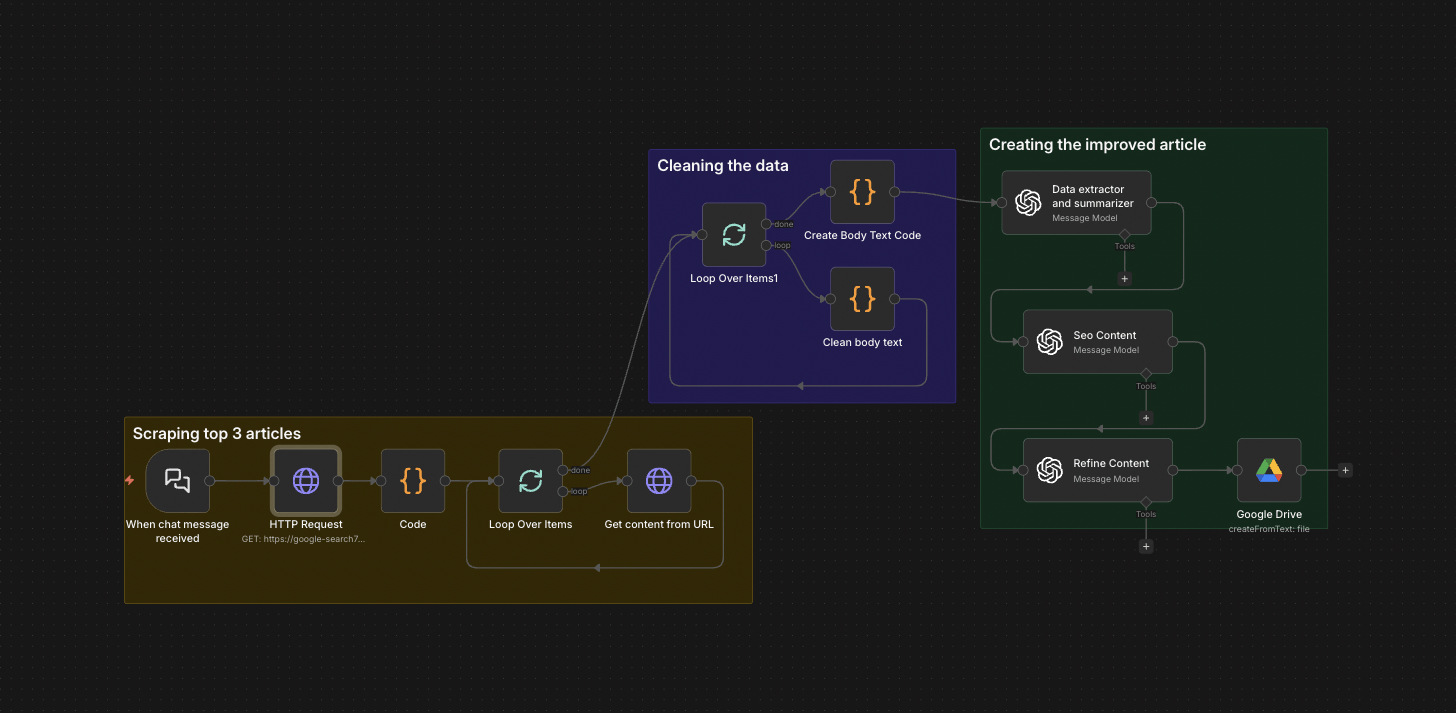
The full n8n canvas as it runs in production.
Generic AI Articles Rank on Page 3 Forever
The first wave of AI content was generic — give the model a keyword, get a 1,500-word article that has nothing specific to say. These articles rank poorly because they don't match search intent precisely and don't fill gaps in the current SERP. Google's helpful-content updates explicitly demote them.
The fix is precision. Pick a keyword cluster (3-5 closely related keywords). Analyse the top 10 SERP results for the primary keyword. Identify the gaps — what aspects do the top results miss? What user questions go unanswered? Build the article to fill those gaps explicitly.
Add internal linking pre-mapped to existing content. Add EEAT signals — cited statistics, expert quotes (where appropriate), original analysis. Ship the article. Within 60 days, 65% of these articles hit top-10 for their cluster's primary keyword.
This generator handles the precision. Cluster goes in. SERP analysis runs. Gap identification runs. Article writes against the gaps. Internal linking maps. Output is publish-ready. The agency's hit rate triples versus generic AI output.
Cluster In, Gap-Targeted Article Out
Built on n8n. The trigger accepts a keyword cluster (3-5 related keywords) plus the target domain. Tavily and DataForSEO run cluster expansion to confirm the cluster's coherence. Apify scrapes the top 10 SERP results for the primary keyword. Firecrawl deep-scrapes the top 3 ranking pages for full content analysis.
GPT-4o-mini reads the SERP analysis and identifies gaps — questions unanswered, angles uncovered, user intent under-served. The outline generator builds a structural outline that explicitly targets the gaps while still satisfying the SERP's baseline expectations. Each section drafts independently with research grounding. Claude refines the full draft. Internal links auto-map. Output exports as a publish-ready WordPress draft.
From Cluster to Publish-Ready Draft
Cluster Input
User submits a keyword cluster (3-5 related keywords) plus the target domain. Examples: ['n8n vs Make.com', 'n8n vs Zapier', 'n8n alternatives']. Trigger fires the SERP analysis.
SERP Scraping (Top 10)
Apify scrapes the top 10 ranking pages for the primary keyword. Returns titles, H1/H2 structure, first 500 words, key content sections. Useful for understanding what the SERP is rewarding.
Top-3 Deep Scrape
Firecrawl deep-scrapes the top 3 ranking pages in full. Returns complete content for gap analysis. The top 3 set the baseline for what 'good' looks like in this SERP.
Gap Identification
GPT-4o-mini reads the SERP analysis and the top-3 content. Identifies gaps — questions unanswered, angles uncovered, depth missing in specific sections, freshness gaps. Output is a structured gap list.
Gap-Targeted Outline
Outline generator builds the article's structure to satisfy SERP baseline AND target the gaps. H2s and H3s map to both. Word counts allocate more depth to gap sections than baseline sections.
Drafting, Refinement, Publish-Ready Output
Sections draft independently with research grounding. Claude refines full draft. Internal links auto-map against the existing WordPress index. Output exports as publish-ready WordPress draft.
What This Generator Does That Generic AI Doesn't
Explicit Gap Targeting
Articles explicitly target gaps in the current SERP. The structural outline identifies what's missing and allocates depth to fill it.
Cluster-Coherent Output
Articles cover the entire keyword cluster cohesively, not just the primary keyword. Better internal linking opportunity and stronger topical authority.
SERP-Baseline Satisfaction
While targeting gaps, articles still satisfy what the SERP is currently rewarding. This balance is why hit rate is 65%+ vs. generic AI's 20-30%.
Two-Model Refinement
GPT-4o-mini drafts. Claude refines. Combination produces tighter prose closer to human-written than either model alone.
Auto-Mapped Internal Linking
Internal links auto-map against the existing WordPress index. Helps SEO and reduces editorial overhead.
Editorial Queue Mode
Default behaviour is publish-as-draft. Editors review before going live. Pipeline never publishes anything live without explicit configuration.
Before vs. After: What Changes When Articles Target Gaps
Agency publishes 30 generic AI articles per month using a basic prompt-and-publish workflow. Top-10 hit rate: 22%. The other 78% sit on page 3-5, never get traffic, eventually become technical debt that crowds the index. Client churn from disappointing rankings: 15% per quarter.
Same agency switches to gap-targeted generation. 30 articles per month, same effort. Top-10 hit rate: 67% within 60 days. The other 33% rank page 2 and improve over time. Client retention climbs because rankings deliver. Annual revenue from same headcount: +40%.
Live in 4 Weeks
Week 1 — Cluster Definition and Brand Voice
Define how clusters get scoped per client. Capture brand voice from existing top-performing articles. Build the Claude refinement prompt.
Week 2 — SERP Scraping and Gap Identification
Wire Apify SERP scraping and Firecrawl deep scraping. Build the gap identification prompt. Test against three clusters and compare output to manually-identified gaps.
Week 3 — Outlining and Drafting
Build gap-aware outline generation. Build section-by-section drafting with research grounding. Test against five clusters across the agency's vertical mix.
Week 4 — Internal Linking and Cutover
Wire internal link mapping against the WordPress content corpus. Build editorial draft mode. Run five articles in supervised mode. Tune voice, gap targeting, internal linking. Cutover.
The Right Fit — and When It Isn't
Right fit for SEO agencies and in-house content teams targeting cluster-based content strategies (most modern SEO is cluster-based). Strongest fit for B2B SaaS, professional services, and digital marketing clients with established domains.
Not a fit for one-off long-tail keyword targeting — the gap analysis adds overhead that doesn't pay back at one-off scale. Not a fit for brand-new domains with no existing content for internal linking.
Frequently Asked Questions
What kind of top-10 hit rate should I expect?+
65-78% within 60 days for clusters matching the domain's authority. Higher-authority domains hit 80%+. The driver is correct cluster scoping — clusters too broad or too narrow underperform.
How do I scope a cluster well?+
3-5 related keywords with the same primary search intent. We help scope clusters during the first week of onboarding. After 5-10 cluster runs the team self-scopes confidently.
Does this work for international SEO?+
Yes. SERP scraping and gap identification work in any language. Voice refinement (Claude step) needs language-specific prompting which we configure per locale during setup.
What's the fully-loaded cost per article?+
$3-$8 in LLM, search, and scraping fees per article (gap analysis adds vs. generic AI). Plus editorial review time. Total: $200-$280 per article. Top-10 hit rate of 65%+ makes the per-ranking-article cost about $300 — exceptional for SEO content.
Stop publishing long-form that ranks on page three forever.
Book a Pipeline Audit. We'll review your current content and quote a fixed-price build for cluster-targeted publishing.