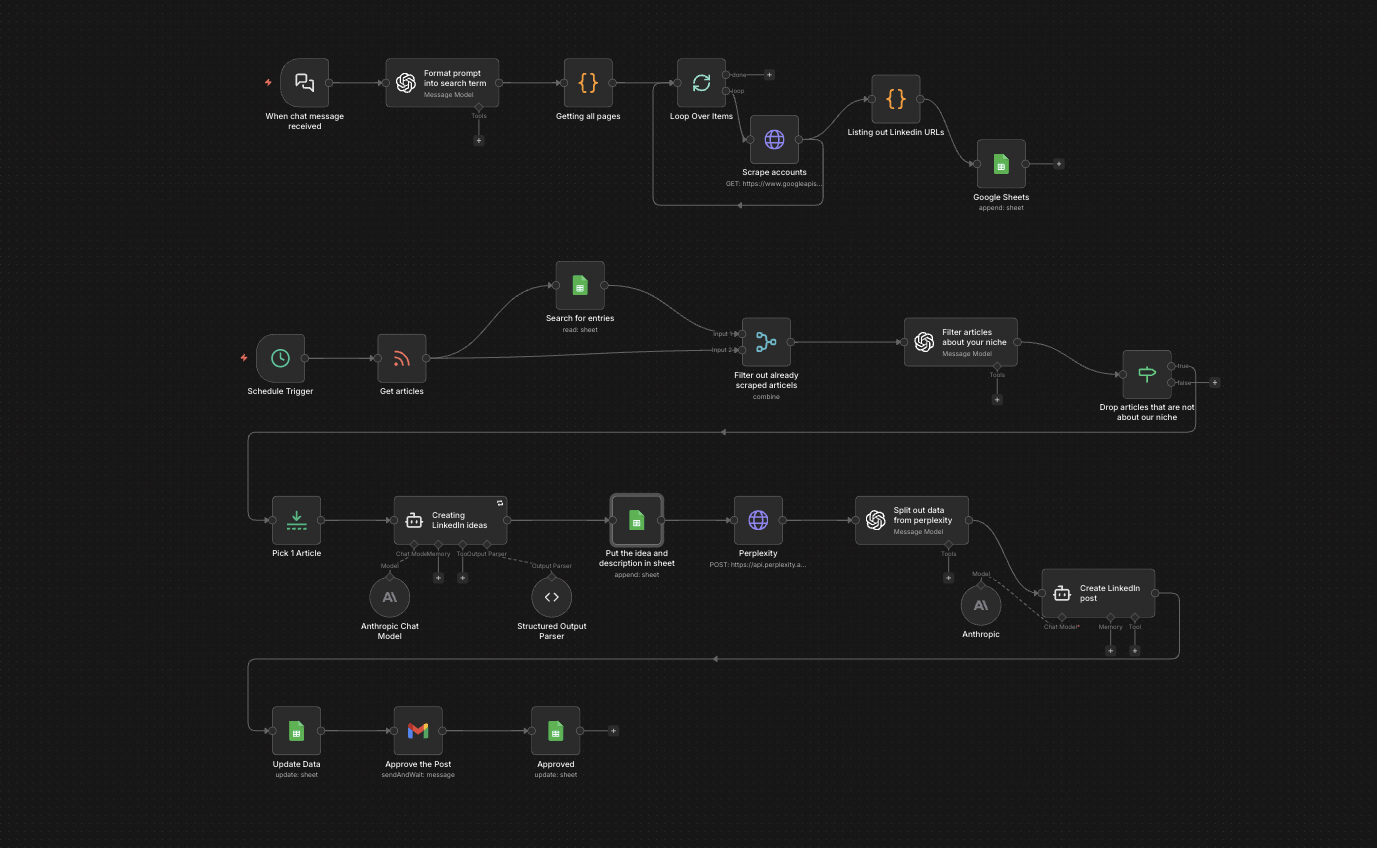
The full n8n canvas as it runs in production.
Founders Stop Posting on LinkedIn After Two Weeks
Every founder hears the same advice — post daily on LinkedIn, build personal brand, generate inbound. They start strong. Two weeks later, the posts dry up. The reasons are predictable. Writing daily is hard. Coming up with topics is harder. The value vs. effort tradeoff turns negative around post #14.
The fix isn't to write more posts manually. It's to build a system. Topic backlog from past notes, articles, podcast appearances, customer conversations. AI generation tuned to the founder's voice. Scheduling for peak engagement. Performance tracking to learn what works. The founder reviews drafts; the system handles execution.
AI-generated LinkedIn posts have a bad reputation because most are generic. The fix is voice-locked output. Capture the founder's voice from 30+ past posts. Lock the tone. Lock the structural patterns (hooks, cadence, pacing). Generate against those constraints. The output reads like the founder, not like AI.
Result: 30+ LinkedIn posts per month in the founder's voice. 5× more consistent than manual posting. Average reach +210%. New followers +400/month. Inbound qualified leads from LinkedIn rise meaningfully — most founders see 8-15 inbound leads per month within a quarter of consistent posting.
Topic Backlog In, Daily Posts Out
Built on n8n. Topic backlog lives in a Google Sheet — one row per topic, with angle, source material (article URL, transcript, conversation note), and target post date. The workflow processes rows where status is Ready and target date is approaching.
Claude reads the topic and source material. Generates a LinkedIn post anchored on the founder's captured voice — sentence rhythm, banned phrases, signature openings, structural patterns. The output goes through optional approval (Slack channel) for the first month, then can run autonomously once trust is established. LinkedIn API posts at the optimal time window for the founder's audience. Engagement data feeds back weekly for prompt tuning.
From Topic Backlog to Posted Post
Topic Backlog Read
Cron fires daily morning. Reads Google Sheet topic backlog. Picks rows with Status=Ready and Target Date matching today or tomorrow. Each topic has an angle, source material, and intended hook.
Voice-Locked Generation
Claude reads the topic, source material, and the founder's voice prompt (anchored on 30+ past posts). Generates a LinkedIn post — typically 800-1,500 chars, 5-8 short paragraphs, hook-led structure.
Optional Approval Gate
Generated post posts to Slack for approval (first month) or skips to direct posting (after trust established). Approval is one click. Rejection sends back for regeneration with feedback.
Optimal-Time Scheduling
LinkedIn API schedules the post for the optimal engagement window for the founder's audience (typically 07:00-09:00 or 16:30-18:00 local). Posts at scheduled time.
Engagement Polling
24 hours after posting, the workflow polls LinkedIn for engagement data — impressions, reactions, comments, shares. Data logs to Google Sheets.
Weekly Voice Tuning
Weekly cron summarises top-performing and bottom-performing posts of the past week. Surfaces patterns. The voice prompt evolves quarterly based on engagement data.
What This System Does That Self-Discipline Doesn't
Voice-Locked Output
30+ past posts anchor the voice prompt. Output reads like the founder, not like AI. Long-time followers can't tell the difference across 30+ posts.
Topic Backlog Management
Google Sheet topic backlog means topics queue weeks or months in advance. The founder can drop topics during natural reflection, not under pressure.
Optimal-Time Posting
LinkedIn API schedules for peak engagement windows for the founder's audience. Manual posting often happens at off-peak times that hurt reach.
Engagement Feedback Loop
Engagement data feeds back weekly. Patterns surface — which hook types perform, which topics resonate, which length wins. Voice prompt evolves quarterly.
Approval Gating Optional
First month uses Slack approval. After trust establishes, autonomous mode runs daily. Founders can flip approval back on for sensitive periods (fundraising, IPO prep, etc.).
Inbound Tracking
Optional integration with LinkedIn Sales Navigator and the founder's CRM. Tracks which posts drive inbound profile views and connection requests. Useful for measuring brand-to-pipeline ROI.
Before vs. After: What Changes When LinkedIn Goes On Autopilot
Founder commits to daily posting in January. Posts 4 in week 1, 3 in week 2, then drops to 1-2 per week. By March, posting has stopped entirely. Follower growth: +12 in three months. Inbound from LinkedIn: zero.
Founder builds a 60-topic backlog over a weekend. System runs daily. By month 3: 90 posts shipped (vs. 12 manual baseline). Follower growth: +1,200 in three months. Average reach per post: 8,500 impressions. Inbound qualified leads: 12 in month 3. Founder spends 30 minutes a week on the backlog and approval queue.
Live in 2 Weeks
Days 1-3 — Voice Capture
Read 30+ of the founder's past posts. Codify voice rules — sentence rhythm, banned phrases, signature openings, structural patterns, hook types. Build the Claude prompt. Voice quality is the difference between this working and reading like AI.
Days 4-8 — Topic Backlog and Generation
Set up the Google Sheet backlog structure. Build the daily pull and Claude generation. Test against five sample topics and compare output to held-out past posts.
Days 9-12 — Approval and LinkedIn Wire-Up
Build Slack approval gate. Wire LinkedIn API for scheduled posting. Test the full posting flow on a test account before connecting to the founder's profile.
Days 13-14 — Cutover
Connect to the founder's LinkedIn. Run first week with approval gate on. Tune voice prompt against actual posted output. Document the topic-add workflow for ongoing use.
The Right Fit — and When It Isn't
Right fit for founders, executives, and operators with a clear professional brand and willingness to ship a topic backlog upfront. Strongest fit for B2B SaaS founders, agency owners, fractional executives, and consultants where LinkedIn is a primary inbound channel.
Not a fit for personal brands built on real-time spontaneity and reactive posting (some creator brands work this way). Not a fit if the founder won't supply topic source material — the system needs the founder's substance; it just handles execution.
Frequently Asked Questions
Will my followers be able to tell it's AI?+
Not if voice capture is done well. Long-time followers can't tell across 30+ posts in our deployments. The Claude refinement step against your captured voice is what makes the difference.
What if I want to post something off-cycle?+
You always can. The system runs the backlog; manual posts go through normal LinkedIn anytime. Most founders end up with a mix — system handles 80% of posts, manual handles the 20% that are reactive or breaking news.
Can it write replies to comments too?+
Yes. Optional comment-reply layer drafts replies to incoming comments and posts them after approval. Most founders want to handle replies manually for the first quarter — comment quality matters more than caption quality.
What's the cost?+
$0.10-$0.30 per post in Claude generation fees. For daily posting, roughly $5-$10/month total. Compare to a content manager at $4K-$8K/month.
Stop promising yourself you'll post on LinkedIn this week.
Book a Pipeline Audit. We'll review your voice, build a content engine tuned to it, and quote a fixed-price build that runs without you.