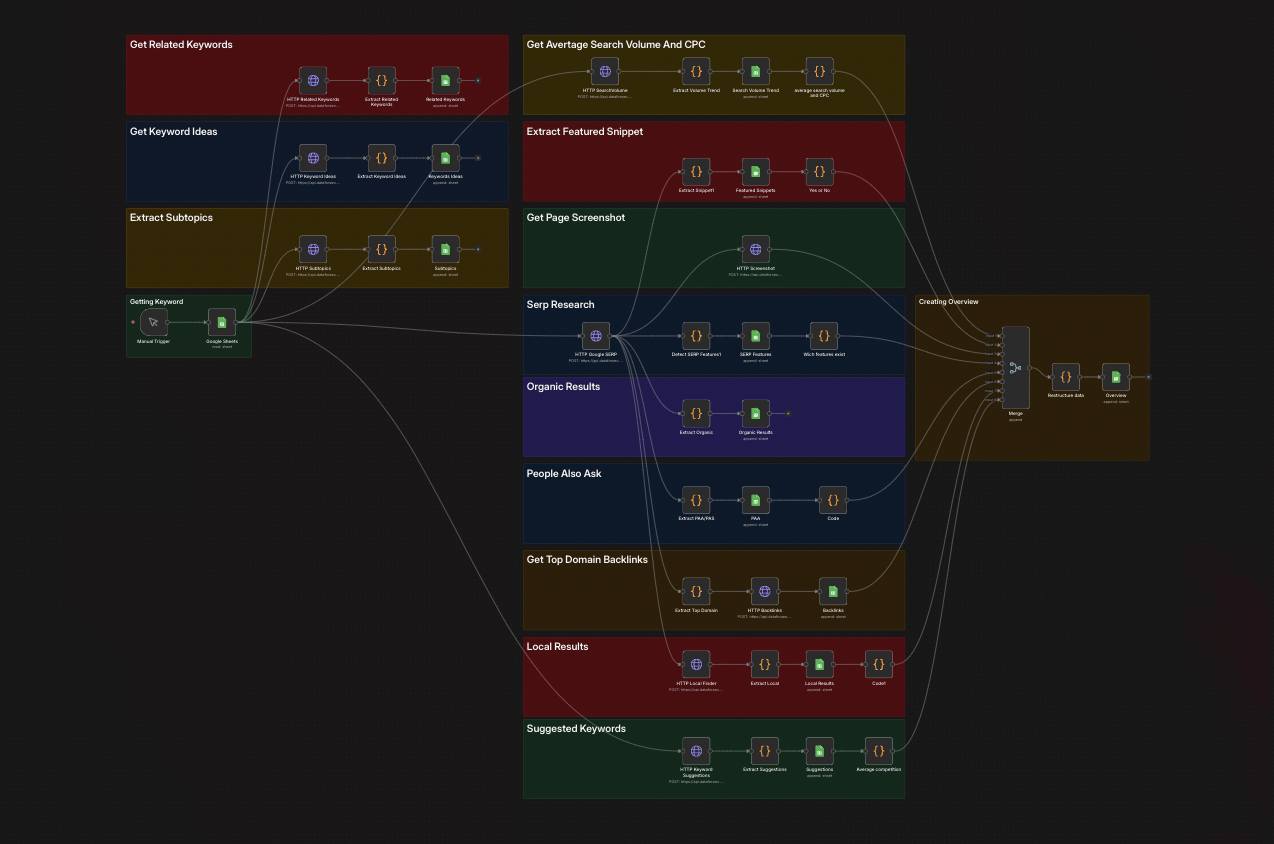
The full n8n canvas as it runs in production.
Most Keyword Research Finds the Wrong Keywords
Standard keyword research tools surface volume. Ahrefs shows 'fintech' has 18,000 monthly searches — great. But ranking for 'fintech' requires a Domain Rating of 80+, three years of authority, and 50+ backlinks. For most domains, going after that keyword is a waste of six months.
The fix is opportunity research, not volume research. Find keywords with real volume AND competition low enough for the domain to actually rank within 6-12 months. The math is volume × commercial intent × (1 / competition relative to domain authority).
Standard tools surface 200 keyword ideas. The opportunity engine ranks them by realistic-rankability. The top 50 are what the content team should target. The bottom 150 might be high-volume but the domain can't win them in any reasonable timeframe.
Add intent analysis — informational vs. commercial vs. transactional — and the team has a content brief queue ranked by both expected ranking effort and expected business value. Run quarterly. The content roadmap stays grounded in what's actually achievable.
Volume Plus Competition Plus Intent
Built on n8n. The trigger is a seed query (or a list of seed queries). DataForSEO returns the keyword expansion — typically 200-500 related keywords with volume, CPC, and competition score. The keyword list flows into the scoring engine.
Each keyword scores on three axes — volume (raw monthly searches), competition relative to the configured domain authority, and intent (informational, commercial, transactional, navigational, classified by GPT-4o-mini). The combined score ranks the keywords by realistic opportunity. Output exports to Google Sheets with the prioritised list and a recommendation per keyword (target, defer, skip).
From Seed Query to Prioritised List
Seed Query Input
User submits a seed query or list of seeds. Examples: 'project management software', 'AI sales tools', 'employee onboarding'. Trigger fires the keyword expansion.
Keyword Expansion via DataForSEO
DataForSEO returns 200-500 related keywords with monthly search volume, CPC (commercial proxy), and competition score (1-100). Total run time: 30-60 seconds per seed.
Domain-Authority-Aware Competition Scoring
Competition score gets adjusted based on the configured domain's authority (DR / DA). A keyword with 70 competition score is hard for everyone but easier for a DR-60 site than a DR-30 site.
Intent Classification
GPT-4o-mini classifies each keyword as informational, commercial, transactional, or navigational. Commercial and transactional weight higher for B2B SaaS. Informational weights higher for content marketing strategies.
Composite Scoring
Each keyword gets a composite score: volume × intent weight × (1 / adjusted competition). Top 50 keywords flag as primary targets. Next 100 flag as defer. Remainder flags as skip-for-now.
Sheets Export with Brief Queue
Output exports to Google Sheets with rank, volume, intent, competition, recommendation, and a 'brief outline' field that pre-populates with the SERP intent and target word count for each keyword. Ready for the content workflow to pick up.
What This Engine Does That Volume Lookups Don't
Realistic-Rankability Scoring
Adjusts competition based on the domain's actual authority. Surfaces what the team can realistically win, not just what has volume.
Intent-Weighted Prioritisation
Commercial and transactional intent weights differently from informational. The roadmap balances volume targets against business-value targets.
Brief Queue Output
Each keyword exports with a pre-populated brief outline — SERP intent, target word count, key competitors. Drops straight into the content workflow as a ready-to-write item.
Multi-Seed Expansion
Run multiple seeds in one batch. Useful for covering a topic cluster — 'project management software', 'project management for startups', 'project management tools' all expand and merge into one prioritised list.
Quarterly Refresh
Re-run quarterly to catch new keyword opportunities and shifts in competition. Most teams discover 30-50 new opportunities per quarter on the same seed.
Cost Per Run
DataForSEO is roughly $0.05-$0.15 per seed expansion. GPT-4o-mini intent classification adds $0.01 per 100 keywords. Total cost per run: $1-$10. Compare to enterprise keyword research tools at $200+/mo.
Before vs. After: What Changes When Opportunity Beats Volume
Content team picks the top 20 highest-volume keywords from Ahrefs. Six months later, 14 of them are still on page 4 because the domain authority is too low. The team has spent 200 hours on content that won't rank for years. The other 6 actually rank but cover lukewarm intent that doesn't convert.
Content team runs the engine. Top 50 surfaces by realistic-rankability + intent. Six months later, 38 of them are top-10 (78% hit rate). 22 of those 38 are commercial-intent and convert at meaningful rates. The team's organic pipeline triples in six months on the same content output.
Live in 2 Weeks
Days 1-3 — Domain Authority Calibration
Confirm the domain's DR/DA. Build the competition adjustment factor against historical ranking data — what competition scores has the domain successfully ranked for in the past 12 months?
Days 4-8 — Expansion and Scoring
Wire DataForSEO. Build the keyword expansion logic. Implement the composite scoring formula. Test against three sample seeds and compare output to manually-prioritised opportunity lists.
Days 9-12 — Intent Classification and Brief Output
Build the GPT-4o-mini intent classification. Wire the brief queue output to Google Sheets. Test against held-out keywords with known intent labels for accuracy.
Days 13-14 — Calibration and Cutover
Run the engine on the team's primary seeds. Walk through the prioritised list together. Adjust scoring weights based on the team's feedback. Hand over for quarterly use.
The Right Fit — and When It Isn't
Right fit for content teams, SEO agencies, and B2B marketers planning their content roadmap. Strongest fit for teams working in established niches with clear ICP and 50+ existing articles to anchor authority calibration against.
Not a fit for brand-new domains with no published content — keyword opportunity matters less than just shipping anything to start building authority. Not a fit for teams targeting only branded or navigational keywords; for those, no analysis beats just writing.
Frequently Asked Questions
How accurate is the realistic-rankability scoring?+
Calibrated against the domain's historical performance. Typically 75-85% accurate at predicting which keywords the team will rank top-10 for within 6 months. We retune the scoring weights every 6 months as the domain evolves.
Can it use Ahrefs or SEMrush data instead of DataForSEO?+
Yes. The expansion source is a single node swap. Ahrefs and SEMrush both have APIs. Most teams use DataForSEO because pricing is best-in-tier; Ahrefs is the default if the team already has an Ahrefs subscription.
How do I know when to re-run it?+
Quarterly is standard. Major business strategy shifts (new product line, new geo) warrant a fresh run. New domain authority milestones (DR climbed 10+) warrant a fresh run because the realistic-rankability frontier shifts.
What's the cost per run?+
$1-$10 per seed expansion depending on keyword count. Most teams run 5-10 seeds quarterly. Total quarterly cost: $50-$300. Compare to enterprise keyword research at $200/mo.
Stop writing articles for keywords your domain can't rank for.
Book a Pipeline Audit. We'll calibrate the research engine to your domain authority and quote a fixed-price build.