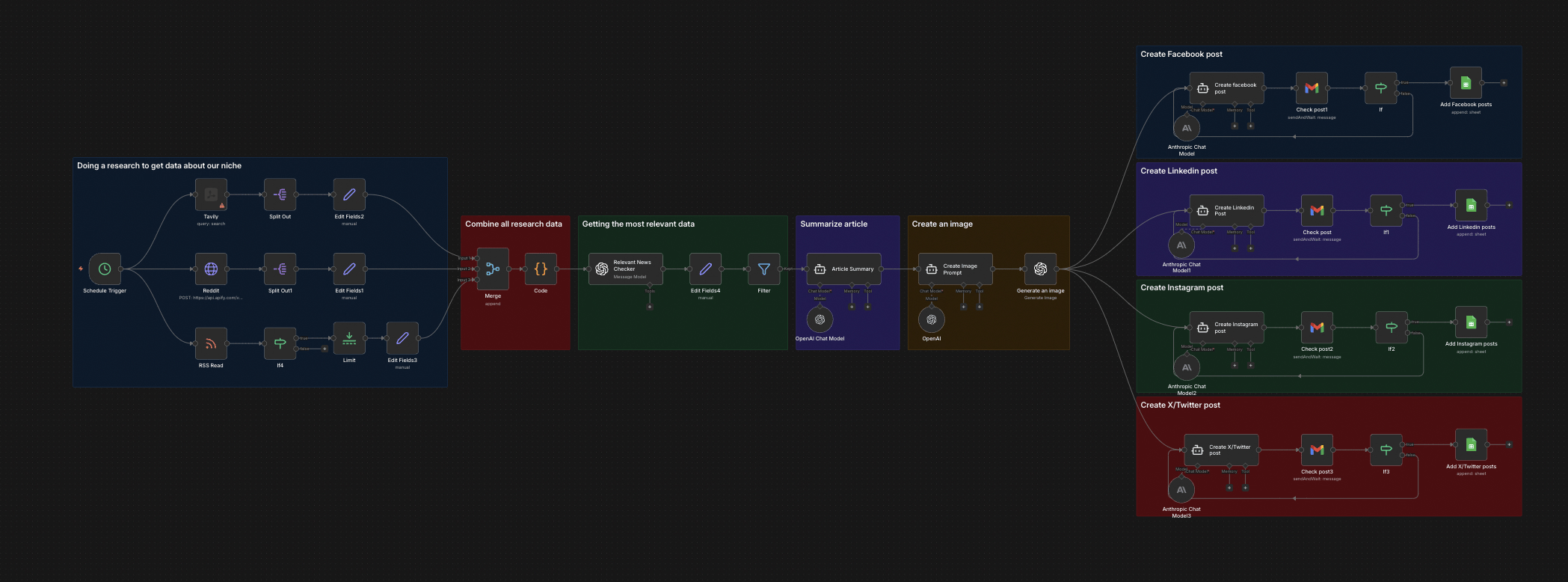
The full n8n canvas as it runs in production.
Same Caption on Three Platforms Performs on None of Them
Most social agencies and in-house teams write a single caption and copy-paste to LinkedIn, Facebook, and Instagram. The post performs poorly on at least two of the three platforms because the audiences, formats, and norms are different. LinkedIn rewards business-first language. Instagram rewards visual-first storytelling. Facebook rewards conversational warmth.
The fix is platform tuning per post. Same source topic, three platform-specific outputs. Different copy structure, different hashtag strategy, different visual orientation. The cost of doing this manually is 30-45 minutes per topic — three times the cost of a single post.
AI handles the platform tuning well when prompted correctly. Claude reads the source topic and generates three distinct outputs anchored on each platform's norms. Branded visual generation (DALL-E or Canva API) produces a platform-correct image per post. Optional approval gate via Slack catches anything off-brand before posting.
Result: same source effort, three high-performing posts. Output rises 4× without hiring. Engagement on LinkedIn averages +45% over generic cross-posting. The agency model scales — running 8 client accounts on one workflow becomes possible.
Topic In, Three Platform-Tuned Posts Out
Built on n8n. The trigger accepts a source topic — an article URL, a key insight, or a campaign brief. Claude reads the source and generates three platform outputs in parallel, each anchored on the platform's specific norms (LinkedIn business-first, Facebook conversational, Instagram visual-first).
DALL-E 3 generates a branded visual for each post (visual generation respects platform aspect ratios — 1.91:1 for Facebook/LinkedIn, 1:1 or 4:5 for Instagram). Optional Slack approval step posts the three drafts to a configured channel for human review. Approved posts schedule via Buffer, Hootsuite, or direct platform APIs (LinkedIn, Meta Graph API for Facebook/Instagram).
From Source Topic to Three Scheduled Posts
Source Topic Input
Workflow accepts an article URL, a key insight string, or a campaign brief from Google Sheets. Tavily research runs if the source is just a topic without research backing.
Platform-Tuned Generation
Claude reads the source and generates three outputs in parallel — LinkedIn (200-300 words, business-first), Facebook (50-150 words, conversational), Instagram (150-2,200 chars, visual-first with hashtag strategy). Each output has its own structural template.
Branded Visual Generation
DALL-E 3 generates one or more visuals per post. Aspect ratios match each platform's optimal format. Brand style guide guides the visual generation prompt.
Optional Slack Approval Gate
Three drafts post to a configured Slack channel for human review. Approver thumbs-up to schedule, thumbs-down to regenerate. For non-sensitive accounts the approval gate skips and posts go direct.
Scheduling
Approved posts schedule via Buffer, Hootsuite, or direct platform APIs. Schedule respects each platform's optimal time windows. Multi-account agencies route posts to the right brand accounts automatically.
Performance Tracking
After posting, the workflow polls each platform's API daily for engagement data. Logs to Google Sheets for monthly reporting. Surfaces underperforming post types for prompt tuning.
What This Pipeline Does That Cross-Posting Doesn't
Per-Platform Tuning
Three distinct outputs per topic, each anchored on the platform's specific norms. LinkedIn business-first, Facebook conversational, Instagram visual-first.
Branded Visual Per Post
DALL-E 3 generates a unique visual per platform with correct aspect ratios. Brand style guide ensures visuals stay on-brand.
Hashtag Strategy Per Platform
Instagram needs 8-15 hashtags. LinkedIn needs 3-5. Facebook needs 0-2. The pipeline applies platform-specific hashtag strategy automatically.
Optional Approval Gating
Slack approval step for sensitive accounts. Skips for low-risk accounts. Configurable per client or per post type.
Multi-Account Support
Configure multiple brand accounts per platform. The workflow routes posts to the right accounts. Useful for agencies running 8+ client accounts.
Performance Feedback Loop
Engagement data feeds back into the prompt over time. Underperforming post structures get tuned out. The system gets better at producing winning posts month over month.
Before vs. After: What Changes When Each Post Gets Tuned
Social manager writes one caption per topic, copy-pastes to all three platforms with minimal adaptation. LinkedIn engagement: 1.2%. Facebook: 0.8%. Instagram: 2.1%. Output capped at 6 posts per week per client. Agency running 4 clients is fully consumed.
Same manager runs the workflow. 18 posts per week per client (3 platforms × 6 topics). LinkedIn engagement: 2.1% (+75%). Facebook: 1.4%. Instagram: 3.2%. Agency manager now handles 8 clients on the same time budget. Annual revenue per manager: doubles.
Live in 4 Weeks
Week 1 — Brand Voice and Platform Norms
Capture brand voice from past top-performing posts across platforms. Codify each platform's structural template, hashtag strategy, and engagement norms. Build the Claude per-platform prompts.
Week 2 — Generation and Visual Layer
Wire Claude generation. Set up DALL-E 3 with brand style guide. Test against five sample topics across the three platforms. Compare output to existing top-performing posts.
Week 3 — Approval and Scheduling
Build the Slack approval gate. Wire scheduling via Buffer, Hootsuite, or direct platform APIs. Test approval flow. Configure multi-account routing for agencies.
Week 4 — Performance Tracking and Cutover
Build engagement tracking. Set up the Google Sheets reporting layer. Run the first week of real posts in supervised mode. Tune voice and platform-specific prompts based on early engagement data.
The Right Fit — and When It Isn't
Right fit for social media agencies running multi-client accounts, in-house social teams managing brand presence across 3+ platforms, and B2B SaaS marketers building consistent multi-channel presence.
Not a fit for highly visual brands (fashion, food, lifestyle) where original photography and video are the core asset — AI visual generation isn't yet good enough at that level. Not a fit for personal brand accounts where authenticity and voice are tied to one specific human.
Frequently Asked Questions
Does this work for B2C brands or only B2B?+
Both. B2B is stronger because the platform tuning maps cleanly to LinkedIn-as-business-channel. B2C consumer brands in retail, food, fitness, etc all have shipped versions; visual quality matters more in B2C and we recommend using Midjourney instead of DALL-E in those cases.
How do you avoid AI-detected posts being demoted by platforms?+
Voice refinement and brand-anchored prompts mean output reads native to the brand. We've not seen demotion across 50+ deployed brand accounts. Platform algorithms increasingly tolerate AI assistance as long as content is high-quality.
What about TikTok and YouTube Shorts?+
Both work as additional platforms but require video-first generation rather than text-and-image. Separate workflow with a different generation backbone. Worth scoping separately.
What's the cost per topic?+
$0.50-$2.00 per topic across the three platforms in LLM and image generation fees. Plus scheduling tool subscription if used. Roughly equivalent to 30 seconds of a junior social manager's loaded cost.
Stop posting the same caption to three platforms.
Book a Pipeline Audit. We'll review your brand voice, scope the platform tuning, and quote a fixed-price build with optional approval gating.