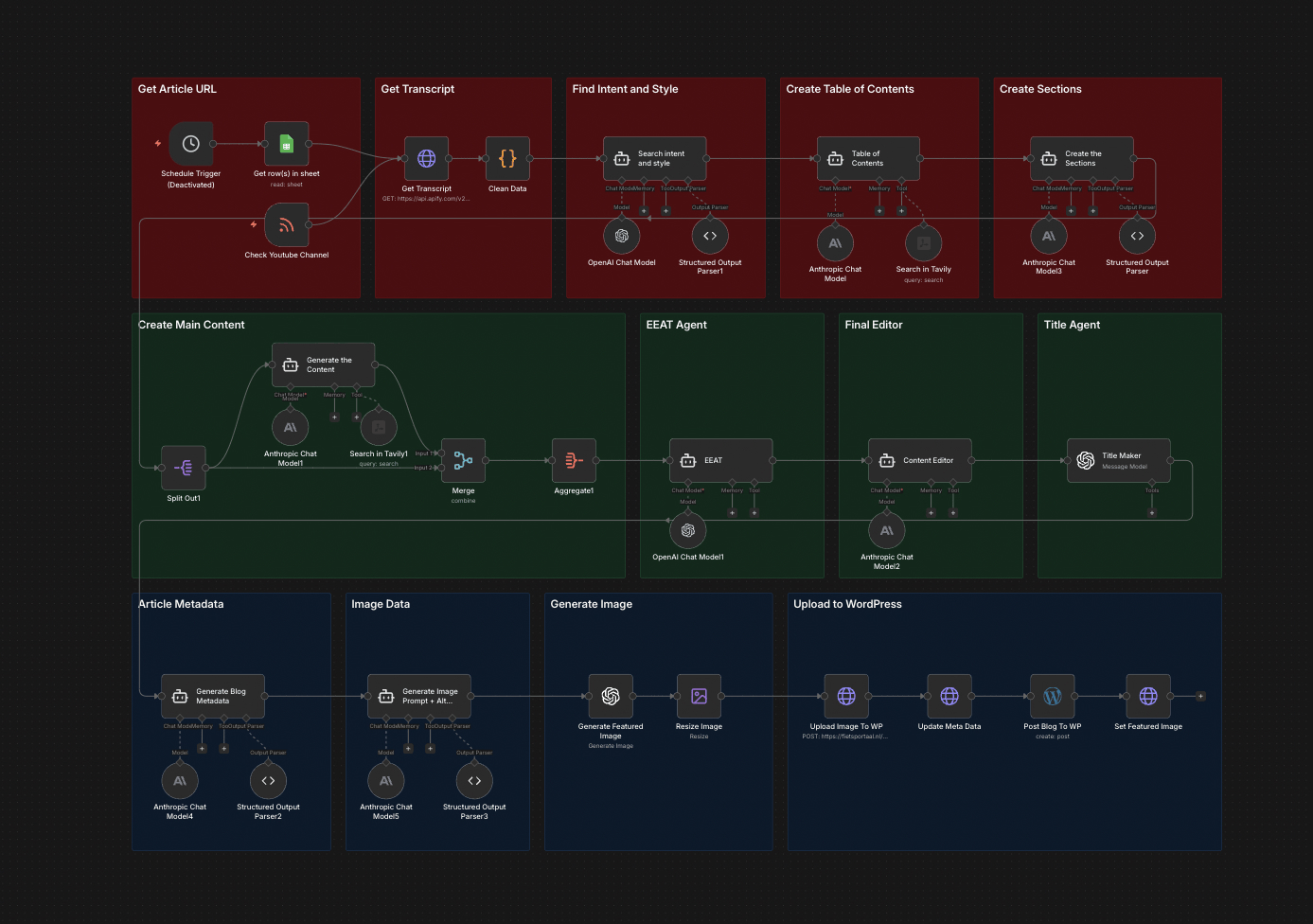
The full n8n canvas as it runs in production.
Your Best Insights Are Trapped in Video
YouTube channels sit on a goldmine of indexed-but-invisible insight. Every 12-minute video contains 1,500-2,500 words of expert content that could rank on Google. Almost none of it does — because video transcripts don't rank, and writing a blog post from scratch for every video takes longer than recording the video did.
The naive fix is to dump the transcript on WordPress. It doesn't work. Transcripts read like spoken English — repetitive, unstructured, full of filler words. Google rewards structure, intent-targeting, and tight prose. A raw transcript is the opposite.
The right fix is restructuring. Pull the transcript. Identify the genuine insights buried in 25 minutes of speech. Restructure into a proper article with H2s, H3s, lead paragraph, takeaway. Add metadata, featured image, internal links to existing content. Ship as a WordPress draft for editorial review.
Result: every YouTube upload spawns a ranked blog post within 24 hours. The channel's reach roughly doubles because the same insights are now indexed for search instead of just video discovery.
From RSS Trigger to Published Post
Built on n8n. The trigger is the YouTube channel's RSS feed, polled every 30 minutes. New videos surface within an hour of upload. The video URL passes to Apify's YouTube transcript actor, which returns the full transcript with timestamps.
GPT-4o-mini reads the transcript and the channel's previous posts to identify article-worthy insights. Claude restructures into a proper post with SEO-targeted H2s, lead paragraph, and takeaway. DALL-E 3 generates a featured image. Internal links auto-map. WordPress publishes as draft. Total cycle: under 90 minutes from upload to draft-Ready.
From Upload to Draft: Six Steps
RSS Polling
n8n polls the YouTube channel RSS feed every 30 minutes. New video IDs surface against a manifest of already-processed videos. New ones trigger the pipeline.
Transcript Extraction
Apify's YouTube transcript actor returns the full transcript with timestamps. If transcripts aren't auto-generated, the pipeline falls back to Whisper transcription on the audio.
Insight Extraction
GPT-4o-mini reads the transcript and identifies article-worthy insights. Filler, off-topic tangents, and self-promotional content gets cut. The output is a structured insight list.
Article Restructuring
Claude takes the insight list and restructures into a proper blog post — SEO-targeted title, H2s and H3s, lead paragraph, conclusion. Word count typically 1,200-2,500 depending on video length.
Image and Metadata
DALL-E 3 generates a featured image. Meta description, open-graph tags, and SEO title generate from the article body. Tags and categories auto-classify.
WordPress Publish + Manifest
WordPress REST API publishes as draft. The video ID logs to the manifest sheet so the next poll skips it. The editorial team gets a Slack notification with the draft URL.
What This Pipeline Does That Transcript Dumps Don't
Insight Extraction, Not Transcript Dumping
AI identifies the article-worthy parts of a video and discards filler. Output reads like a written article, not a transcript.
SEO-Targeted Restructuring
H2s and H3s generate against search intent for the video's topic. Articles rank because they're structured for search, not for spoken delivery.
Featured Image Per Post
DALL-E 3 generates a brand-aligned featured image for every post. No more 'we forgot the hero image' delays.
Auto-Mapped Internal Linking
The pipeline queries WordPress for related published posts and inserts contextual internal links automatically.
Editorial Draft Mode
Default behaviour is publish-as-draft. Editors review before going live. The pipeline never publishes anything live without explicit configuration.
Multi-Channel Support
Add additional YouTube channels with one config row. The pipeline handles multi-channel orgs without forking the workflow.
Before vs. After: What Changes When YouTube Feeds the Blog
Channel publishes a 14-minute video on Tuesday. By Friday, nobody has written the blog version. Three weeks later, the editorial team finally drafts an article from notes — by then the topic is stale and the video has 12k views the blog could have captured.
Tuesday, the video uploads. Tuesday afternoon, the WordPress draft is in the editor's queue. Tuesday evening, the editor reviews and publishes. The blog post indexes within 48 hours and starts ranking inside two weeks. Channel traffic doubles over the quarter because the same insight reaches both audiences.
Live in 3 Weeks
Days 1-5 — Channel Audit and Voice Capture
Audit the channel's last 20 videos. Identify which ones are article-worthy (most aren't — vlogs and shorts get filtered). Codify the channel's voice and structural patterns from existing blog posts if any.
Days 6-12 — Transcript and Restructuring Layer
Wire RSS polling, Apify transcript actor, the insight extraction prompt, and Claude restructuring. Test against three recent videos and compare to manually-written blog versions.
Days 13-17 — WordPress and Image Generation
WordPress REST API integration. DALL-E 3 image generation against brand style guide. Internal link mapping. Slack notifications.
Days 18-21 — Calibration and Cutover
Three articles ship in supervised mode. Editors review and give feedback. We tune voice and SERP targeting. Handover and documentation.
The Right Fit — and When It Isn't
Right fit for YouTube channels publishing 4+ videos per month with educational, expert, or analytical content. Channels in B2B, finance, technology, marketing, and consulting are the strongest fits.
Not a fit for vlog-style channels where the value is personality rather than transferable insight. Not a fit for short-form-only channels — videos under 5 minutes typically don't have enough article-grade content to restructure.
Frequently Asked Questions
What if the video is mostly visual demos?+
We add a visual-frame extraction step using Apify or Whisper-with-screenshots. Demo screenshots embed inline as the article walks through them. Works well for product demos and tutorial content.
Can it ignore certain video types like Shorts or live streams?+
Yes. The RSS trigger filters by video type, length, and tags. Most channels filter out Shorts under 60 seconds and any video tagged 'vlog' or 'live'.
How long does the published article need to be?+
Configurable. We typically target 1,200-2,500 words for ranked content. Shorter videos generate shorter articles — quality over forcing length.
What's the cost per article?+
$2-$5 per article in transcript scraping, LLM, and image generation fees. Compare to $250-$500 per article for a writer to watch the video and write the post manually.
Stop letting your best video insights die inside YouTube.
Book a Pipeline Audit. We'll review your channel, model the SEO upside of repurposing each video, and quote a fixed-price build.